- From a Local Business Supporter in Japan to a Conversation with Steve Blank
- Prelude: Five Minutes of Panic and Relief
- Successful Entrepreneurs Listen to Customers, Not Just Their Business Plans
- What Remains Important in Customer Development?
- Small Experiments Work for Local Businesses, Too
- The Real Meaning of “Talking to 100 People”
- Why I Created RISER
- A Framework Is Not Enough: People, Process, and Resources Matter
- AI Can Lower the Barrier. But Someone Still Has to Take the Step.
- “I Can’t Wait to See What You Do Next.”
From a Local Business Supporter in Japan to a Conversation with Steve Blank
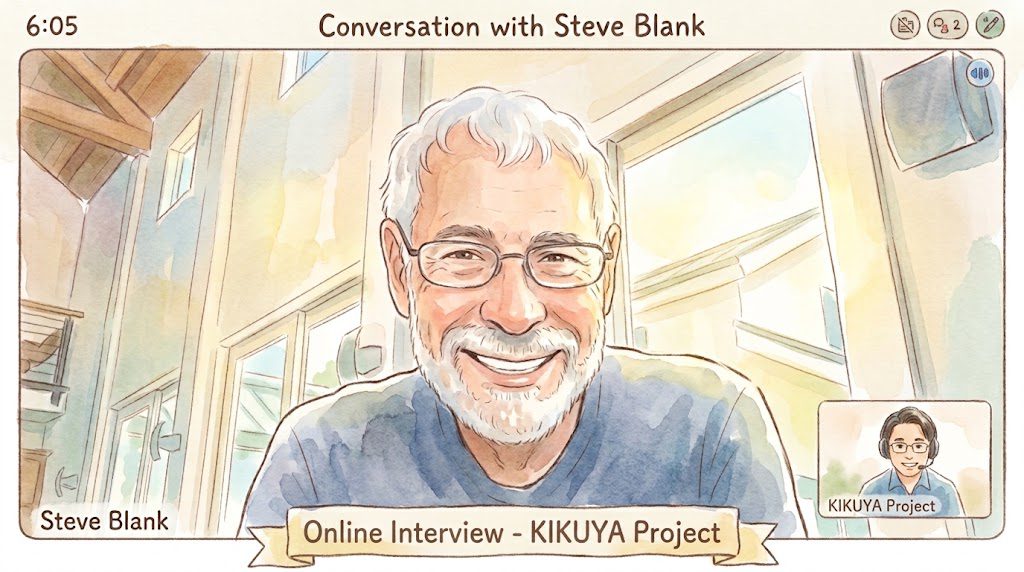
On September 29, 2026, I had the opportunity to speak directly with Steve Blank, the creator of Customer Development and one of the key figures behind the Lean Startup movement.
I am a small-business owner and local business supporter based in Niigata, Japan. I do not speak English fluently. Yet, with the help of AI, I was able to cross a language barrier that would previously have felt almost impossible.
My work focuses on supporting small businesses in the Chuetsu region of Niigata, Japan. Rather than simply managing social media accounts for clients, I try to work alongside business owners and help them think through their customers, communication, and business development.
My interest in customer development grew through this hands-on experience. As I worked with local businesses, I began to notice that the frameworks I already knew did not always explain what I was actually seeing in the field.
In particular, I found myself struggling to organize the relationship between reach, customer inflow, signals of interest, engagement, and retention. That eventually led me to develop my own framework, which I call RISER.
At first, RISER was simply a way to understand social media activity. Over time, however, I began to see it as a broader model for thinking about business growth.
Around the same time, I was studying Customer Development and Lean LaunchPad. The more I learned, the more I wanted to understand the ideas directly from the person who had developed them.
There was only one problem.
I am not an English speaker.
So I decided to use AI as a bridge.
I used AI as a sounding board while writing an email to Steve Blank, explaining what I was doing in Japan, why his work had influenced my thinking, and why I wanted to ask him a few questions.
I sent the email.
And then, unexpectedly, he replied.
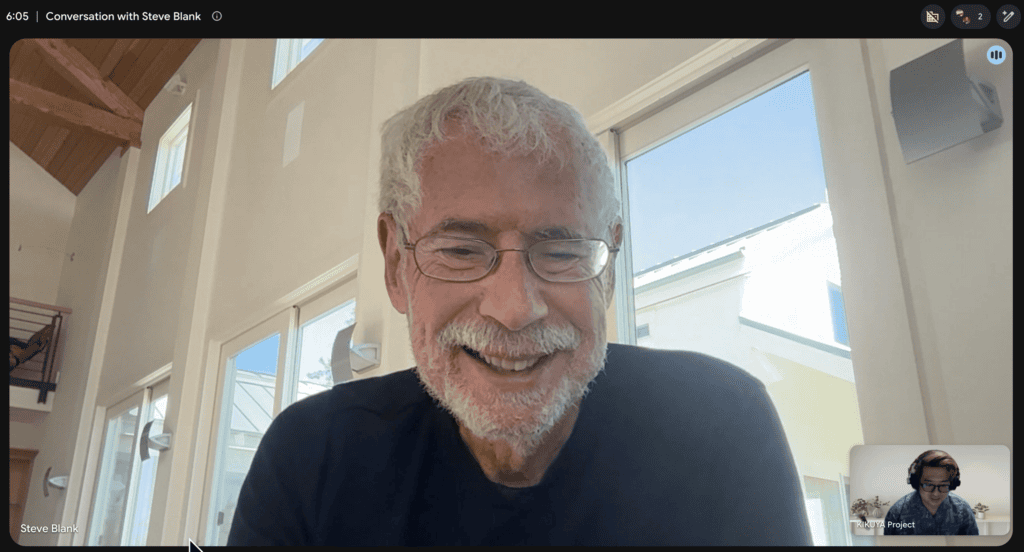
That reply eventually led to a one-on-one conversation on Google Meet.
Prelude: Five Minutes of Panic and Relief
The beginning of the meeting was probably more stressful for me than the actual interview.
My English is far from fluent, and I knew that having a real-time conversation with someone whose work I had studied for years would be very different from writing an email with AI’s help.
Fortunately, Google Meet’s real-time translated captions helped bridge the gap. I could listen to Steve’s English while using the Japanese captions to confirm what I had heard.
There were still moments when the captions were imperfect, and there were parts of the conversation that were difficult to catch. But Steve was patient, and the conversation continued naturally.
What had felt almost impossible when I first considered sending the email became a real conversation.
That experience itself was one of the most important lessons of the day:
AI does not have to replace the human connection. Sometimes, it simply makes the connection possible.
Successful Entrepreneurs Listen to Customers, Not Just Their Business Plans
One of my first questions was about the origin of Customer Development. I wanted to know what Steve had actually observed in his own experience that led him to develop the approach.
His answer was straightforward.
“I started customer development because I had done eight startups in 21 years.”
Steve explained that, after working on those startups and later sitting on boards of both private and public companies, he noticed a pattern.
“The companies that succeeded ignored their business plan and actually paid attention to what customers were asking them for.”
This was especially interesting to me because it gets to the heart of Customer Development.
A business plan can describe what a company expects to happen. Customer Development is about discovering what is actually happening in the real world.
The successful founders Steve observed were not simply executing their original plans. They were learning from customers and changing the plan itself when reality told them to.
For someone working with small businesses in a local market, this idea feels particularly relevant.
What Remains Important in Customer Development?
I then asked Steve what he believed was still essential in Customer Development, even after all the changes in business and technology over the years.
His answer focused on something deeper than simply “talk to customers.”
“What remains more important is understanding all the stakeholders, the problems they have, the needs they have, how they connect, the hierarchy—where the users are, the recommenders, decision makers, requirements writers, how they all connect with each other.”
This made me reconsider what “customer understanding” actually means.
In many businesses, the person using a product is not necessarily the person making the purchasing decision. There may also be recommenders, influencers, decision makers, or people who define the requirements.
Understanding the structure connecting these people can be just as important as understanding the end user.
Small Experiments Work for Local Businesses, Too
I explained that my work is focused on small businesses in the Chuetsu region of Niigata. These businesses often have much smaller markets and fewer resources than the startups usually discussed in Silicon Valley.
That raised a question for me:
Can the principles of Customer Development and Lean LaunchPad still work when the available market, money, and people are limited?
Steve’s answer was essentially yes.
He gave the example of someone opening a small restaurant. Instead of immediately signing a lease, buying equipment, and committing to a complete business model, the entrepreneur could start by asking simple questions.
Where do people eat now? How do they choose where to eat? What is missing from the current food service? Is there a need that is not being met?
Then, instead of immediately building the entire business, the entrepreneur can test the idea. Give people samples. Ask for reactions. Try different locations. Consider operating from home. Test whether people actually come to a particular place.
The important point is not any single experiment. It is the accumulation of small experiments.
One small test leads to another. Each result changes what you know. And what you learn determines what you test next.
For local businesses, this approach may be especially practical because business owners are often geographically close to their customers. They may be able to observe, ask, test, and learn without requiring the kind of resources associated with a large startup.
The Real Meaning of “Talking to 100 People”
One topic I wanted to clarify was the often-repeated idea of talking to 100 people.
I asked Steve how many people a small business owner in a town of around 25,000 people should actually talk to before making a decision.
The conversation made one thing clear to me:
100 is not a magic number.
Steve explained the context of a teaching assignment in which students spend ten weeks talking to 100 people. The purpose is to get students out of the building and into the real world.
What matters is not reaching a predetermined number for its own sake. What matters is recognizing patterns in what people tell you.
“What you want to find is: are you starting to get the same answers?”
He explained that you can change the way you ask the question and approach the same issue from different angles. When you repeatedly hear similar answers, you begin to see a pattern.
“I’ve asked this three or four different ways and it seems to be yes, that people are interested, and then you go to the next experiment.”
That distinction is important. Customer interviews are not about collecting a certain number of opinions. They are about learning enough to decide what should be tested next.
Why I Created RISER
I then introduced Steve to RISER.
When I first started supporting businesses through social media, I tried to understand what was happening through existing marketing frameworks such as AIDMA and AISAS.
But after working with actual businesses, I felt that those models did not fully make sense of what I was seeing in my own practice.
So I created RISER.
The framework consists of five elements:
- R — Reach: Are people encountering the business?
- I — Inflow: Are people moving from awareness toward the business?
- S — Signal: Are they showing signs of interest?
- E — Engagement: Are meaningful interactions taking place?
- R — Retention: Are those relationships continuing?
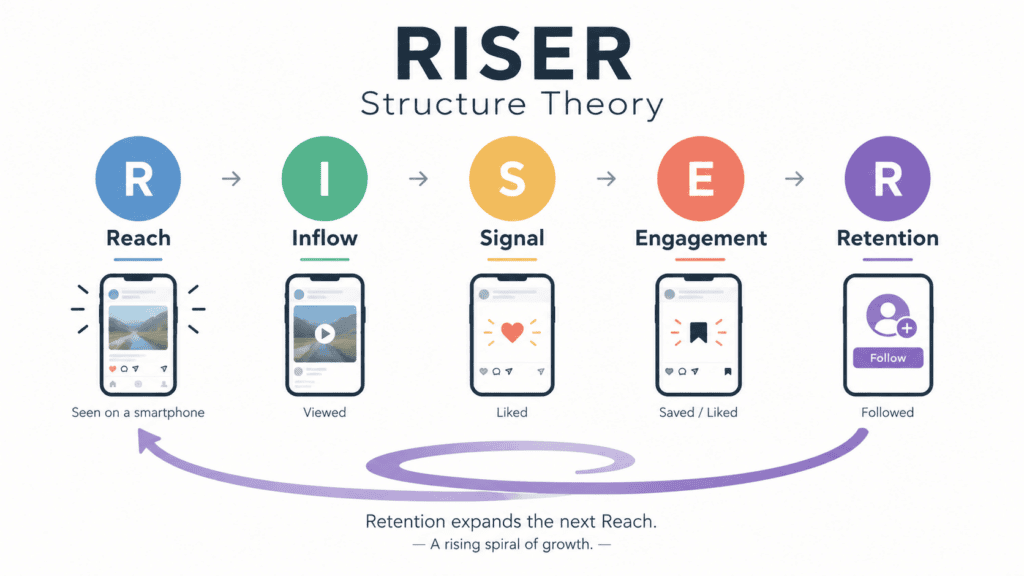
Rather than viewing these stages as a one-way funnel, I see them as a cycle. Retention creates the foundation for the next wave of Reach, allowing the business to grow through repeated cycles.
I explained that what began as a framework for understanding social media eventually became a broader way of thinking about business growth.
Steve’s response was interesting. Although parts of the conversation were difficult to capture accurately through automatic transcription, the discussion clearly identified similarities between RISER and funnel-based approaches, particularly around building relationships.
I do not interpret this conversation as Steve Blank formally endorsing or validating RISER. Rather, the value for me was being able to place my own framework into a conversation with the ideas of Customer Development and Lean LaunchPad.
That distinction matters.
RISER is still my own framework, developed from my own practice. The conversation helped me see both where it overlaps with established thinking and where I need to continue developing it.
A Framework Is Not Enough: People, Process, and Resources Matter
I then asked Steve what he thought might be missing from RISER.
This part of the conversation was particularly valuable because it shifted the discussion away from frameworks themselves.
A framework can help you understand what is happening. But someone still has to use it.
“That’s why an instructor will always have a job or a coach.”
In other words, knowing a framework does not automatically mean that a business owner can apply it effectively. The people using the process, the way they learn, and the support they receive all matter.
But Steve went even further.
When I asked what was most important when supporting small businesses, he pointed to resources and key activities.
“The RISER part is critical, but do they need to raise money? Do they need to get a building? Do they need to understand the financials? There is an environment in which RISER fits, but there are other pieces to make a successful business.”
He also emphasized that, for small businesses, money and the ability to hire the right people can be just as critical as understanding how to acquire customers.
This connected directly with something I had already experienced in my own support work.
In one case, a client’s social media awareness was gradually increasing. The business was getting more visibility, but customer acquisition took time. Eventually, the business ran out of financial room and the client had to cancel the support.
That experience taught me an uncomfortable but important lesson:
customer development alone cannot keep a business alive if the business does not have enough resources to survive the learning process.
A framework can show you where you are. It cannot create the money, people, skills, or operational capacity required to continue.
AI Can Lower the Barrier. But Someone Still Has to Take the Step.
Near the end of the conversation, I asked Steve about entrepreneurship in the age of AI.
I also told him about an AI-related workshop I am planning to attend in November, where Thomas Both will be involved.
Steve asked what the workshop was designed to teach and whether it involved students learning how to use large language models.
He also mentioned that he was preparing a completely new syllabus and invited me to look at it after it was released.
But perhaps the most meaningful AI-related part of our conversation had actually happened before the interview.
I had used AI to help me write the email that reached Steve. I did not use it to pretend that I was fluent in English. I used it to help me express my own ideas clearly enough to start a conversation.
When I asked Steve why he had agreed to speak with me after receiving that unexpected email, he said:
“Your use of AI in the email was perfect.”
He also said that the email was thoughtful and that he was interested in what I was doing.
That was a surprisingly powerful moment for me.
AI did not create the idea. It did not create the desire to talk with Steve. And it certainly did not take the interview for me.
It simply reduced the barrier between an idea in my head and a person I wanted to reach.
Someone still has to send the email. Someone still has to make the call. Someone still has to leave the building and talk to customers.
AI can lower the barrier. It does not remove the need to take the first step.
“I Can’t Wait to See What You Do Next.”
At the end of the conversation, I told Steve that I wanted to continue studying business and keep helping local business owners improve their businesses.
Then he said:
“You did a good job. I can’t wait to see what you do next.”
For me, this was more than a compliment.
It felt like an invitation to keep testing.
I am not working in Silicon Valley. I am working with small businesses in regional Japan, where markets are smaller, resources are limited, and relationships often matter enormously.
But the fundamental question remains the same:
Are we building our business based on what we assume people want, or are we actually going out and learning what they need?
My conversation with Steve Blank did not give me a final answer. It gave me more questions to test.
And perhaps that is exactly the point.
Get out of the building. Talk to people. Test your assumptions. Learn. Change the plan when reality tells you to. Then run the next experiment.
From a small city in Niigata to a conversation with Steve Blank, AI helped me cross one barrier. Now the real work begins.
Profiles
Steve Blank
Steve Blank is an entrepreneur and educator known for developing Customer Development and for his influence on the Lean Startup movement. His work emphasizes testing business assumptions through direct interaction with customers and the market rather than relying solely on a fixed business plan.
Official Website: https://steveblank.com/
Keisuke Hanyu (Representative of KIKUYA Project / Chuetsu Life)
Keisuke Hanyu is the representative of KIKUYA Project and the creator of Chuetsu Life, a local media and business-support project based in Niigata, Japan. He supports local small businesses through social media strategy, customer communication, and hands-on business development.
His current work focuses on exploring how Customer Development, AI, and practical field-based support can be adapted to the realities of regional small businesses.
Editorial Note
This article is based on a recorded online conversation held on September 29, 2026. Because real-time translation and automatic transcription were used during the meeting, some portions of the conversation were difficult to capture precisely. Direct quotations in this article are limited to portions that were sufficiently clear in the English transcript. Where the meaning was less certain, the conversation has been paraphrased rather than presented as a direct quotation.
コメント